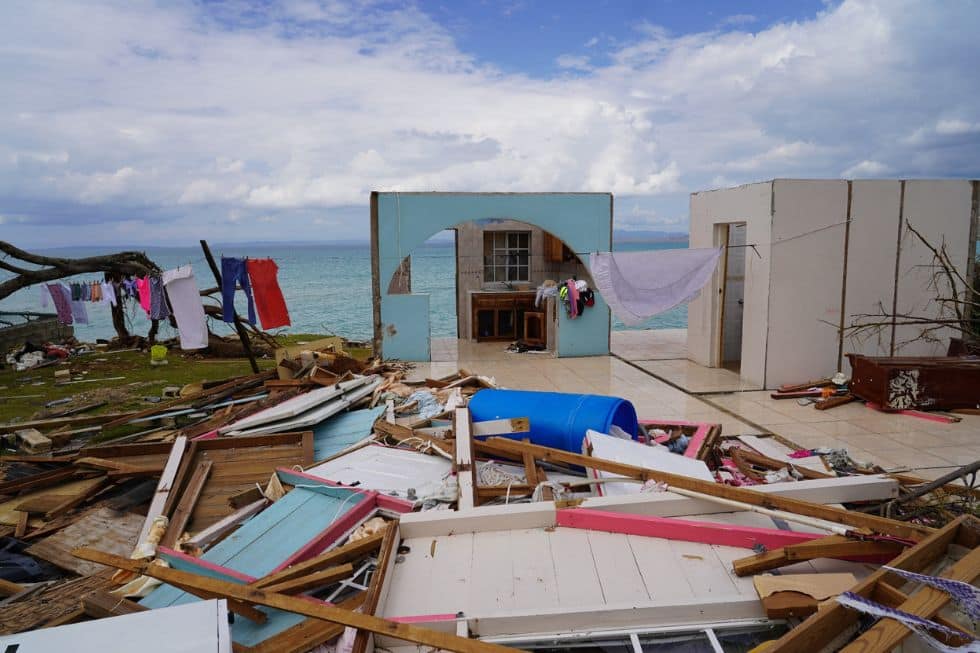

In late October, Hurricane Melissa — a Category 5 storm — slammed western Jamaica with winds near 185 mph, shredding roofs, destroying hospitals and municipal buildings, snapping telephone poles, flattening crops and sending floodwaters through communities. The storm left roughly $8 billion in damage and hundreds of thousands without power and food security. Survivors described homes turned into “rubbish heaps” and shelters filled beyond capacity. For many Jamaicans, the experience was not an abstract warning; it was a collapse of the everyday conditions of life and “civilization.”
Melissa’s ferocity was not accidental. It was fueled by an overheated Caribbean Sea, warmed by centuries of industrial carbon emissions that have trapped heat in the atmosphere. Scientists estimate Melissa was roughly a third stronger than it would have been without human-driven climate change. As ocean and air temperatures rise, hurricanes don’t simply grow a little stronger; their potential energy increases dramatically. Researchers are already debating whether the Saffir–Simpson scale is now inadequate — some suggest a new Category 6 for storms that exceed historical bounds.
In the same week that UN officials were describing an “apocalypse” in Jamaica, tech billionaire Bill Gates published a blog post urging calm, arguing that climate change “will not lead to humanity’s demise” and warning against hysterical doomsaying. Gates framed the debate in a way that attacked a straw man: scientists and activists pushing for urgent emissions reductions do not claim the human race will be wiped out tomorrow, but they do warn of large-scale collapses of infrastructure, livelihoods and governance — the kinds of losses already visible in Melissa’s wake.
Gates’s intervention matters because of who he is: a representative of monopoly-scale wealth whose net worth rivals the GDP of small nations and whose outlook often reflects the priorities of Silicon Valley’s elite. When he minimizes near-term catastrophic outcomes, it reshapes public debate. Meanwhile, many in tech have quietly shifted from being pro-science champions to defenders of their own business models. That shift is driven in part by the explosive rise of artificial intelligence and the infrastructure that powers it: data centers and the chips that run large language models.
AI’s growth has created a voracious appetite for electricity and cooling. Graphics-processing units and massive data centers consume vast amounts of power and water. MIT researchers warned that by 2026 data centers’ electricity use could approach 1,050 terawatt-hours — comparable to the annual demand of large countries. By 2030, new data centers might drive a significant share of global electricity demand. Noman Bashir of MIT cautions that the pace at which companies are building these facilities means most of their electricity will come from existing fossil-fuel power plants, making a sustainable rollout impossible without a dramatic expansion of clean energy capacity.
That economic logic helps explain why influential parts of the high-tech sector are less eager to press for rapid decarbonization. When the financial upside of AI is immense, and the capital to build energy-hungry infrastructure is available, the companies and investors behind that boom have a monetary incentive to slow climate policy that would raise energy costs or constrain growth. In practice, this can align Silicon Valley with Big Oil’s interests and help fuel anti-science or anti-climate-policy campaigns. The defunding and firing of government scientists — including those in climate-monitoring agencies — further weakens the public’s capacity to respond to extreme weather and long-term climate threats.
Political decisions compound the problem. In the United States, measures to curtail climate action and to slash funding for scientific agencies have left monitoring programs understaffed; volunteers have sometimes had to step in to track major storms. Internationally, current policies announced by governments put the world on a perilous trajectory: the UN’s recent emissions-gap assessments still project global warming toward roughly 2.8°C under today’s policies, down from a yet worse path but far above the 1.5°C threshold climate scientists warn is critical to avoid the worst consequences.
Why focus on near-term emissions? Because of the carbon budget. There is a finite amount of carbon dioxide humanity can emit if we want a good chance of keeping warming near 1.5°C. Recent estimates indicate only about 130 billion tons of CO2 remain in that budget — at current emission rates, we would exhaust it in roughly three years. Even a looser ceiling, such as limiting warming to 1.7°C, would be consumed within a decade. That urgency is scientific, not rhetorical: each year of delayed reductions commits the planet to more extreme heat, storms, droughts and sea-level rise.
The outcomes of higher warming are not just statistical: they matter for livability. Scientists use a combined measure of humidity and air temperature — “wet-bulb” temperature — to assess when humans can no longer cool themselves by sweating. Wet-bulb thresholds already scare climatologists: sustained exposure to certain combinations of heat and humidity can be fatal. Regions from the Gulf of Mexico to parts of the Middle East and South Asia could face repeated life-threatening wet-bulb events if warming continues. NASA and other agencies warn that within decades even some Midwestern U.S. states could encounter dangerous wet-bulb conditions. Think of a world where large swathes become too hot and humid to work, farm or even survive outdoors for hours. That is not science fiction; it is a plausible projection if emissions do not fall steeply.
Compounding these atmospheric risks is the weakening of nature’s carbon sinks. For centuries the ocean and the terrestrial biosphere absorbed roughly half of human-emitted CO2. But ocean uptake is temperature-sensitive: warmer surface waters hold less carbon and provoke chemical changes that make the seas more acidic, threatening phytoplankton and marine food webs. If oceanic absorption falters, more CO2 will remain in the atmosphere for millennia, locking in longer-term heating and further destabilizing climate systems.
The climate crisis also carries massive human-security implications. The UN and humanitarian groups project that by 2050 hundreds of millions will face climate-driven displacement and need assistance annually. Recurrent, intensifying disasters like Melissa will not only create immediate humanitarian crises but will erode the social and economic fabric that underpins governance, health systems and food security — conditions that, in aggregate, represent the erosion of “civilization” for many vulnerable populations.
So what should be done? The core message of scientists and frontline communities is straightforward: rapid, deep cuts in greenhouse gas emissions are essential now. That includes decarbonizing electricity, halting new fossil-fuel infrastructure, and curbing energy-intensive expansions — including the unchecked growth of data centers unless they run on genuinely additional clean power. It also means protecting and restoring natural sinks, investing massively in adaptation for those already suffering, and reversing policies that hollow out scientific capacity.
Tech industry leaders can play a constructive role, but only if their commitments match the scale of the crisis. Empty pledges or calls for calm that ignore the carbon budget and the immediate harms already occurring will not help communities rebuilding after storms like Melissa. The comparison to a computer’s blue screen of death is apt: unlike digital systems, a crashed planet cannot be rebooted. We have limited margin for error; our remaining carbon budget is a hard constraint. The moral and practical choice is to align resources, policy and corporate strategies with the survival of complex societies — not their continued erosion.
[TomDispatch first published this piece.]
[Kaitlyn Diana edited this piece.]
The views expressed are the author’s and do not necessarily reflect Fair Observer’s editorial policy.