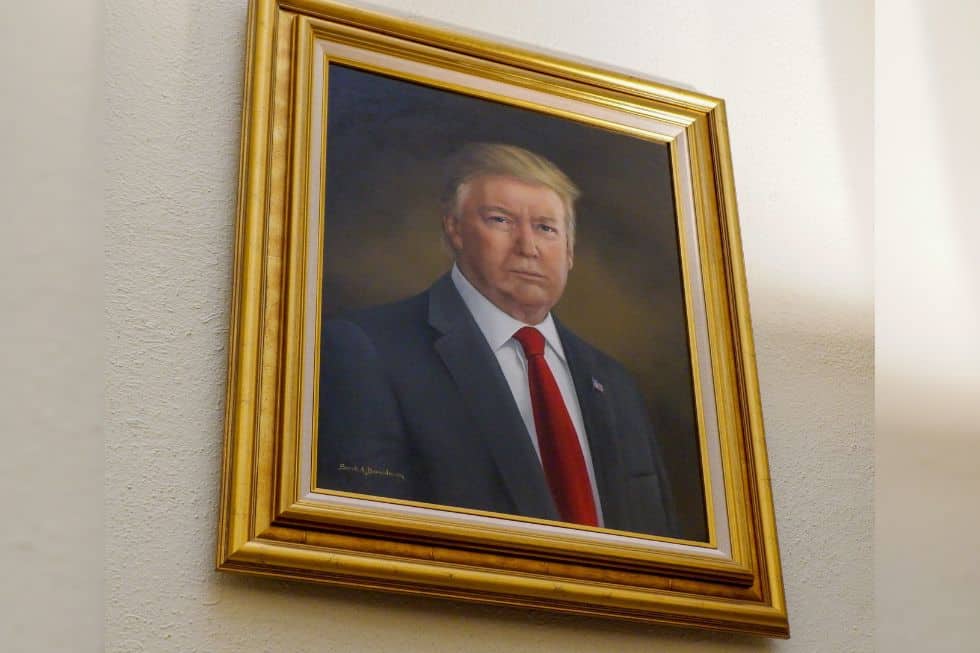

Earlier this year, a controversy over Sarah A. Boardman’s portrait of President Donald Trump in the Colorado Capitol crystallized a larger conversation about conservative influence on the arts. Trump called the portrait flat and lifeless and asked that it be replaced — a judgment that struck a chord because it exposed both a legitimate aesthetic critique and a deeper problem: a conservative visual agenda that often mistakes surface fidelity or nostalgia for artistic merit.
What do we mean by “conservative art”? It is not simply art made by conservatives or art tied to a party. Rather, it describes a sentimental, retrospective imitation of past styles that trades conceptual risk and formal innovation for reassurance, moralism and grievance. It overlaps with kitsch or academic revivalism but is distinct in its political adjacency: it uses a venerated past as a political antidote to contemporary and progressive art.
The second Trump administration’s cultural moves make the stakes clear. The White House reviewed Smithsonian exhibitions it deemed politically objectionable, the administration pushed drastic funding cuts to the National Endowment for the Arts, and an executive order promoted traditional architecture while disparaging contemporary styles. Initiatives such as America250 and state-level grants supporting patriotic murals are mostly neutral civic projects, but they combine with conservative cultural institutions — PragerU’s Founder’s Museum, the National Garden of American Heroes, and sympathetic commentators — to form a nascent federal aesthetic strategy that tends toward nostalgia and replication rather than creative renewal.
That conservative posture contrasts with the inventiveness of many contemporary works conservatives criticize. Simone Leigh’s widely discussed US pavilion at the Venice Biennale, for instance, offered sculptural complexity and cultural rethinking that simply would not be produced by the sentimental reproductions championed by reactionaries. Similarly, progressive and experimental artists often extend the Western tradition by building on it, not discarding it.
A leading example of the conservative visual movement is the Art Renewal Center (ARC). Founded in 1999 to champion “classical realism,” ARC valorizes 19th-century academic painting and denounces Modernism as a “scam.” In competitions and galleries ARC promotes technically polished, neoclassical works and venerates figures like William-Adolphe Bouguereau. But much of the output it elevates displays the principal flaws of conservative art: exceptional surface finish but little imagination or conceptual depth. The ARC often freezes the techniques of academic training into a formula, assuming that a mode used as a teaching scaffold should be the sole standard for art outside that context. The result can be centralized, stagey compositions and an overemphasis on “fine mimicking of surface detail” at the expense of structure, spatial dynamism and expressive looseness.
Critics note that this approach is often moralistic, sentimental and grievance-driven. The ARC’s defenders treat technical mimicry as moral and cultural preservation, but that confuses craft with vitality. Even when ARC artists are technically skilled, their work can feel static and disconnected from the incremental experimentation that defines the Western tradition.
Political conservatives, meanwhile, have sometimes embraced pure kitsch. The administration’s apparent fondness for Thomas Kinkade — a painter whose high-chroma, overly tidy Americana often reads as saccharine mass-market decoration — and its promotion of Jon McNaughton’s propagandistic political tableaux illustrate a tendency to equate decorous nostalgia with cultural authority. The Department of Homeland Security posting Kinkade’s Morning Pledge to accompany immigration messaging is an emblematic conflation of policy and sugary aesthetics: an attempt to legitimate policy through idealized, ahistorical imagery.
That pattern risks legitimizing an aesthetic that privileges appearance over substance. The ARC’s taste for polished surface detail, Bouguereau-style poses and market-driven prettiness echoes the same stagnation that killed Boardman’s portrait. Replacing one lifeless likeness with another technically better but still superficial painting does not vindicate a conservatism that seeks to quash complexity; it only rebrands kitsch as patriotism.
Yet the Western tradition the ARC claims to protect was never static. The history of great art shows continuous evolution: masters loosened their brushwork as they matured; later styles built on, transformed and sometimes overturned earlier conventions. Titian’s late looseness, Rembrandt’s evolving handling of light and texture, Velázquez’s dynamic compositions, Goya and Delacroix’s expressive shifts — these are all internal developments within the tradition, not departures to be purged. Modernism and subsequent movements, for all their challenges to academic orthodoxy, often built on and repurposed earlier lessons rather than annihilating the past.
If conservatives genuinely care about the figurative tradition and standards of excellence, the right response is not a punitive crusade against “woke” institutions or a frozen revival of the academy. Instead, policy should support the existing, vibrant institutions and movements that teach craft while embracing evolution. The Art Students League in New York, ateliers teaching representational techniques, many art schools and innovative figurative movements (like “disrupted realism”) exemplify how technical rigor and contemporary experimentation can coexist. Artists such as Jenny Saville, Alex Kanevsky and Phil Hale work deeply within art history while producing formally and conceptually adventurous painting that is both rooted and innovative.
Conservative cultural policy, then, should be constructive rather than reactionary. Rather than subsidizing sanitized reproductions or weaponizing nostalgia, federal support could strengthen schools, ateliers and museums that teach solid technique, encourage apprenticeships and fund residencies where tradition and contemporary inquiry meet. This would create patrons of heritage who recognize that the Western artistic lineage is defined by cumulative change, not by faithful ossification.
The difference is visible in presidential portraiture. Gilbert Stuart’s Washington reads as a believable, volumetric figure through subtle brushwork and convincing modeling; Reagan’s White House portrait shows warm painterly touch; Obama’s Kehinde Wiley melded realistic portraiture with contemporary cultural specificity. By contrast, portraits that are mere reproductions of photographs or exercises in surface likeness — however neat — fail to capture the craft, context and human complexity that mark great art. Conservatives who assert the value of tradition should defend works that both honor technique and engage history imaginatively.
Finally, the conservative art agenda faces a practical political limit: the art world remains dominated by progressive and pluralist institutions. What conservationist policy can realistically do is foster legitimacy for conservative tastes, but it cannot erase broader curatorial and market trends. The more consequential choice is whether conservatives will use cultural policy to stoke culture wars or to fortify substantive institutions where craft, history and contemporary experimentation converge.
If conservatives truly wish to preserve and champion the Western artistic tradition, they should abandon punitive “anti-woke” campaigns and superficial revivals. They should instead invest in and celebrate institutions that teach craft, encourage innovation within tradition, and support artists who build on the past rather than merely copying it. That path would make them patrons of an evolving heritage — not its saboteurs.
The views expressed in this article are the author’s own and do not necessarily reflect Fair Observer’s editorial policy.