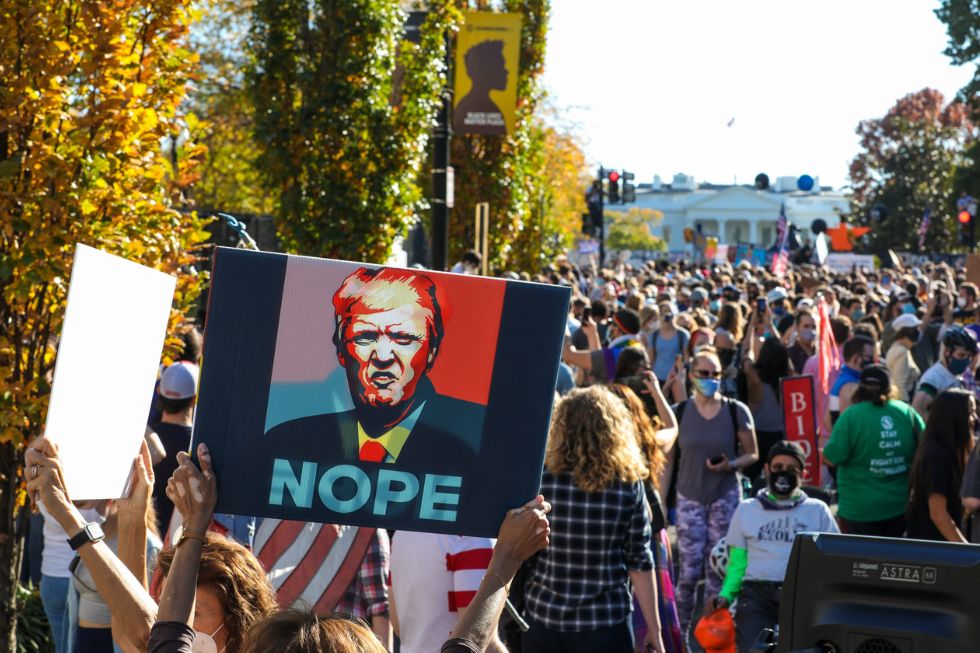

On October 18 nearly seven million Americans marched in protest — roughly 2% of the U.S. population — and, two weeks later, higher-than-expected turnout in important off-year races produced a string of Democratic wins on November 4. Yet amid mass protest and surprising electoral gains, Democratic leadership has offered little coherent, forceful strategy to check the steady erosion of governance under President Donald Trump.
Party leaders appear to be banking on a future “mid-term” reprieve in November 2026 rather than organizing immediate, bold political action. That passivity was on display during the recent government shutdown. A unified, confrontational opposition could have used the shutdown to highlight Republican intransigence and to rally public outrage behind concrete demands. Instead, Senate Democrats failed to translate crisis into cohesive resistance, shying from the hard political choices that credible opposition sometimes requires.
Contrast that absence of leadership with local victories that did present a blueprint for sustained collective action. Zoran Mamdani’s victory in New York City showcased an explicitly coalition-building approach: bring working-class voters into a durable alliance with progressive officials to reverse the exploitation of ordinary people by wealthy elites. Mamdani’s passion and plan point to what national Democrats urgently need: a message and a strategy that link daily economic and social grievances to institution-saving politics.
Yet at the national level the impetus for accountability remains muted. Consider the impeachment resolution introduced on April 28, 2025, by Representative Shri Thanedar (D–MI). Five cosponsors initially signed on; four quickly withdrew, leaving only Representative Al Green (D–TX) in support. With well over 200 House Democrats, the near-absence of endorsements signals a reluctance to publicly embrace a formal accountability mechanism — even as many citizens demand a clear response to repeated abuses.
If House Democrats were serious about showing what accountability might look like, they could at minimum read and publicly endorse the resolution, stage a visible floor effort, and force a debate. Such a move would project unity, frame the stakes to the electorate, and challenge Republicans to take responsibility for the breakdown in governance.
The list of alleged abuses and risky directives growing daily is long. Recent actions attributed to the president include efforts to secure a punitive $230 million payment; unauthorized demolition and lavish redesign work at the East Wing paid for with funds raised from corporations and private donors seeking influence; ordering military strikes at sea that reportedly killed unidentified occupants of vessels in international waters; and talk of restarting nuclear testing. Whether each allegation would meet legal thresholds is for courts and investigators to determine, but the aggregate pattern fuels a narrative of impunity and institutional strain.
At home the human consequences are immediate and deep. Thousands of government employees have been fired, furloughed, or sidelined as experts are removed from positions where their work protected public health, safety, and welfare. Millions of Americans face heightened food insecurity, rising healthcare costs, and the worsening effects of structural racism — conditions that cry out for coordinated political remedy. Yet the political center and much of elite leadership have not assembled a sustained, broad-based movement to confront these harms in ways that can force policy changes and legal consequences.
There is a moral and strategic vacuum. What if the millions who marched and the many more who face daily insecurity organized beyond protest and occasional electoral bursts? What if labor, community organizations, health-care advocates, civil-rights groups, and aligned elected officials built a unified movement with an action plan: press congressional oversight, publicize abuses, support independent investigations, push for legal referrals to international and domestic courts where appropriate, and mobilize voters around concrete protections for programs and people at risk?
Such a movement would not just aim to win an election in a year; it would seek to defend institutions, protect vulnerable communities now, and make clear that dismantling governance and the rule of law has consequences. Political courage will be required: risking short-term popularity to hold fast to principle, leveraging legislative tools, and insisting that elected representatives take visible stands.
The alternative is to hope, passively, that anger and electoral dissatisfaction themselves will suffice. That hope ignores the reality that coherent strategy and leadership are necessary to translate outrage into durable political power and into safeguards against further institutional damage.
If the Democrats — and civic institutions more broadly — fail to act, the consequences will be borne by the hungry, the sick, the marginalized, and the many ordinary public servants whose lives have been upended. The movement of millions in the streets showed there is energy. The November local wins showed the potential of organizing. What is now required is leadership that turns protest and ballots into sustained collective action demanding accountability, preserving democratic norms, and protecting people who depend on government to survive.
The choice is simple in theory though difficult in practice: assemble and act now with courage and a plan, or wait and risk that the moment passes while institutions further erode. The country’s future — and the lives of millions who cannot wait — hinge on which path is chosen.