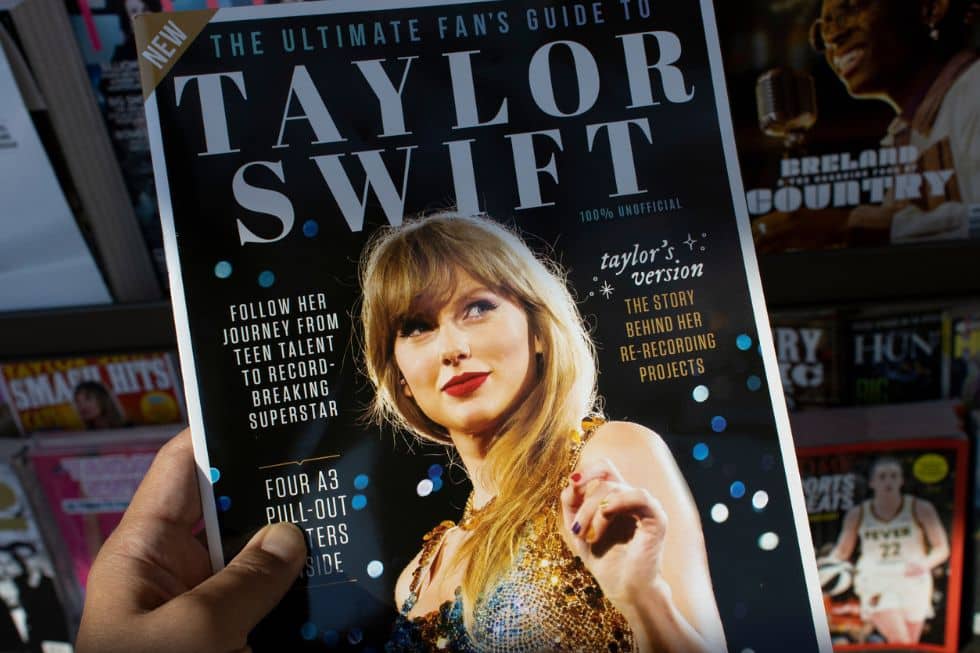

To those who follow the zeitgeist, Taylor Swift is the defining person of our moment: a distillation of present moods and identities. She reflects restless, shifting selves while her own life is relentlessly mediated and co-constructed by millions of fans who do more than consume — they participate. To others, she is simply a songwriter who, quite inexplicably to some, rules the world.
When Swift’s The Life of a Showgirl sold more than four million copies in its first week, commentators reached for superlatives. Her 12th album outsold recent landmark releases; her Eras Tour has grossed more than $2 billion. She has placed record sales and touring revenue back at the center of cultural conversation, turning vinyl, CDs and limited “variants” into relics of devotion. Quantitatively, Swift’s achievements are staggering. But metrics are not the same as artistic greatness.
Comparisons with the greats of popular music — Elvis, the Beatles, Michael Jackson, Madonna — are understandable. Each of those artists transformed the cultural landscape: Elvis repackaged American blues into a white teen obsession; the Beatles expanded the tonal and conceptual horizons of pop; Michael Jackson fused visual spectacle and music to remake MTV and global pop; Madonna weaponized video and image to unsettle norms around sex, gender and religion. They were innovators of presentation, genre, and industry.
Swift’s claim to such company is different. She is not an out-on-the-edge inventor of a new musical idiom. Her albums revolve around recurring motifs — heartache, unrequited love, breakups — and critics sometimes accuse her of recycling melodies or retreading familiar ground. Yet originality in the 21st century often looks less like invention and more like translation: the ability to convert private emotional states into mass cultural texts. Swift industrializes intimacy. She manufactures an economy in which confessional lyricism feels directly addressed to each listener, even as it fuels huge commercial enterprises.
This translation is distinct and powerful. Where artists such as Joni Mitchell, Lana Del Rey or Hayley Williams elicit critical admiration for lyricism and nuance, none has galvanized a comparable industrial and cultural reach. Swift fuses authorship, entrepreneurship and emotional connection on a scale that reconfigures how pop music functions. That fusion is the reason some scholars and commentators have begun to place her in conversations traditionally reserved for canonical artists and writers.
The comparisons to Shakespeare, Picasso or Beethoven are not purely rhetorical. Ryan Adams once called Swift “like Shakespeare”; university courses now treat her catalog as literature; scholars analyze her formal devices, narrative structures and emotional range in ways once reserved for canonical poets and playwrights. Executives and critics have likened her to Picasso for the way she revisits and reworks past work (her Taylor’s Version re-recordings are literal and symbolic reclaims). Conductors have drawn parallels between her storytelling through music and the large emotional arcs of classical composers.
But historical perspective complicates claims of immediate transcendence. Many artists now hailed as titans were underappreciated in their time — Van Gogh sold almost nothing, Schubert’s great works were little heard, and Shakespeare himself was one among many Elizabethan playwrights until later generations elevated him. Greatness, in this sense, is as much a function of later recognition and institutional canonization as of intrinsic quality. It is an attribution produced by a social consensus sustained over time.
This leads to two connected questions. First: will future audiences still listen to Swift? Second: will the cultural agreement that now names her “great” endure long enough to place her in an enduring canon?
On the first, Swift’s themes — love, heartbreak, identity, self-discovery — are universal enough to have staying power. She has already shown a capacity to reinterpret her own catalog, suggesting flexibility. But longevity is not merely a matter of adaptability; it is also about the capacity of work to invite continual reinterpretation, appropriation and reinvention by later artists and institutions. Plays like Ibsen’s Hedda Gabler or symphonies like Beethoven’s Ninth persist because they expose moral tensions, social dynamics and psychological architectures that successive eras can stage anew. Much of Swift’s work is closely tied to 21st-century moods, platforms and celebrity structures; some songs might be robust enough to be re-covered, adapted or sampled, but much of her output is likely to remain bound to her own performance and persona.
The second question — permanence in the canon — turns on the social nature of greatness. If greatness is an ascription rather than an intrinsic property, then Swift already qualifies in one sense: vast audiences, critical attention and institutional study have ascribed to her a significant cultural status. But canonical permanence demands more than contemporary consensus; it requires sustained valuation across generations, backed by institutions (academia, publishing, performance repertoires) and practices (adaptation, translation, pedagogical inclusion). Shakespeare endures not just because his writing is admired but because institutions have continually reproduced and reinterpreted it.
There are also aesthetic differences. Shakespeare’s plays and Ibsen’s dramas possess architectures — dramatic structures, character complexities, ethical dilemmas — that invite endless reinterpretation. Picasso’s reinventions of form and medium altered the grammar of visual art. Beethoven’s musical structures redefined symphonic possibility. Swift’s genius, by contrast, lies in narration through persona and the commodified intimacy of modern media; she excels at rendering private feeling as public property. That is potent now, but it is not the only route to historical immortality.
History is full of artists whose reputations fluctuated. Some were deemed unstable in life and visionary in death; others were canonized by later movements. Greatness can emerge slowly and unexpectedly. If future generations find in Swift work that helps them understand their era’s emotional life or if her songs become sites of reinterpretation and adaptation, her presence in the long-term canon is possible. If not, she may be remembered chiefly as a monument to her moment — the defining artist of an era whose mechanisms of fan participation, social media mediation and commercial reinvention marked a new cultural logic.
For now, Swift has already achieved greatness in a practical sense: audiences and critics have conferred on her an exceptional status, and she sits comfortably alongside major figures of pop history. Whether she will be read alongside Shakespeare and Picasso in the centuries to come remains an open, perhaps unanswerable, question. Greatness, like history, is a collective act of recognition that unfolds over time.
So the most defensible position may be a measured one: Swift is unquestionably among the defining cultural artists of the early 21st century. She transforms the relationship between private feeling and public spectacle and exerts commercial and cultural power rarely matched. Whether that power will translate into the lasting, interpretive, institutionally reinforced kind of greatness that secures a place in a distant canon depends on factors beyond immediate acclaim: how her work is adopted, adapted and taught; whether it proves flexible enough to be meaningful without her singular presence; and how future audiences value the aesthetics she embodies.
Predicting the reception of music across centuries is impossible, but if history teaches anything, it is that the status of “great” can emerge slowly, be contested and be reimagined. Taylor Swift has already secured an extraordinary present. The verdict on her permanence awaits the patient arbitration of time.
[Ellis Cashmore’s The Destruction and Creation of Michael Jackson is published by Bloomsbury.]
[Kaitlyn Diana edited this piece.]
The views expressed are the author’s own and do not necessarily reflect Fair Observer’s editorial policy.