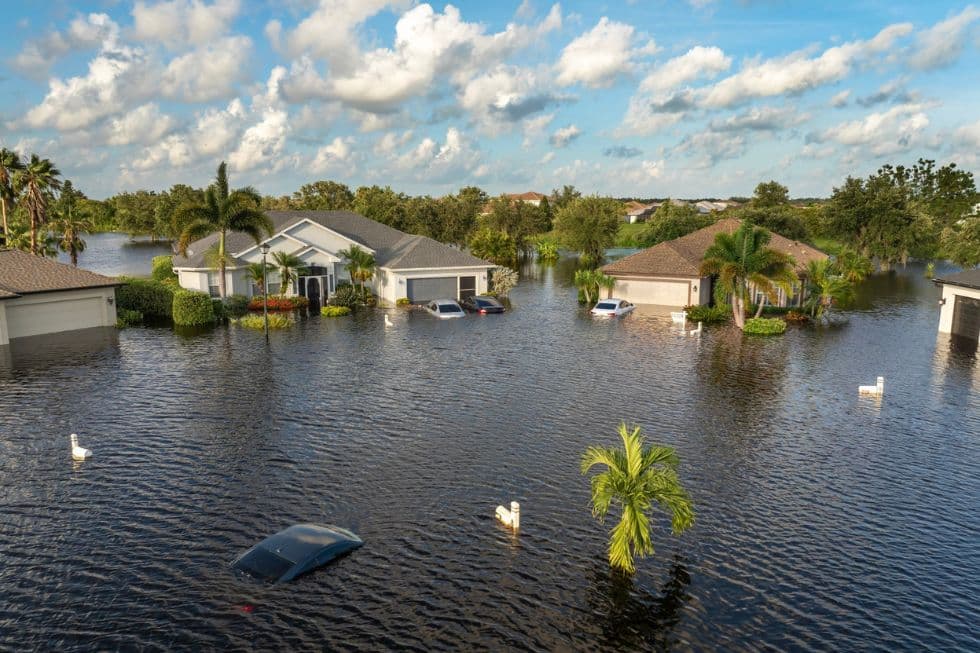

When Hurricane Ian struck Florida in 2022 it produced more than $110 billion in damage and left homeowners facing skyrocketing premiums or no coverage at all. From California wildfires to Vermont floods, private insurers are retreating from high-risk markets as climate-driven losses climb. Nearly one in five U.S. homeowners now live in counties where insurers have reduced or withdrawn coverage. Millions are underinsured and increasingly dependent on slow, politically fraught federal disaster aid. The result: a U.S. climate insurance crisis that exposes how institutions built for historical risk are failing in an era of accelerating extremes.
Traditional indemnity insurance depends on past loss data and lengthy claims adjudication. In a changing climate, historical baselines no longer reflect future risk, pushing premiums up and prompting insurers to exit markets. At the same time, recent federal retrenchment from long-term mitigation—suspending programs such as BRIC and FMA, removing forward-looking standards and cutting public planning tools—has shifted adaptation costs onto states, cities and households. FEMA’s emphasis on faster post-disaster response over pre-disaster mitigation widens the gap between rising climate volatility and the resources available to manage it.
Indexed, or parametric, insurance offers a different approach. Payouts are triggered automatically when a measurable event crosses a pre-agreed threshold—rainfall totals, wind speeds, stream heights—so payments arrive quickly without lengthy damage verification. International precedents are instructive: CCRIF provides rapid payouts to Caribbean governments after hurricanes, and African Risk Capacity pays drought-related claims before food insecurity spirals. Corporations and municipalities in the U.S. are experimenting with parametric contracts—new wildfire products in California show private-market interest—but households and small businesses remain largely excluded.
Parametric insurance could be adapted for public resilience. State disaster agencies might buy indexed policies that trigger direct relief to households, removing claim friction and speeding recovery. Local governments could purchase community-level parametric coverage to stabilize budgets after shocks. Small businesses—cafés shuttered during evacuations, fisheries losing income during storms—could receive rapid, index-triggered payments that preserve cash flow and jobs. Municipal “climate-triggered” bonds already under consideration in places like New York and Miami apply similar logic: connect financial instruments to climate metrics so capital flows when risks materialize.
But indexed products have key challenges. The most important is basis risk: triggers don’t always match individual losses. A homeowner could suffer catastrophic localized flood damage even if nearby gauges record below-threshold rainfall. That mismatch is especially acute where environmental monitoring is sparse. Wealthier regions tend to have dense sensor networks and sophisticated modeling; rural and low-income areas do not. Without investment in high-resolution, publicly accessible hazard data, parametric solutions will leave vulnerable populations behind.
Reducing basis risk requires public investment in granular climate and hazard information—improved rainfall and streamflow gauges, soil moisture sensors, localized wildfire risk mapping—and open access to those datasets. NOAA and NASA are improving county-level hazard tools, but more localized, interoperable data layers are necessary. Models underpinning triggers must be transparent and auditable; beneficiaries and regulators need to understand how thresholds are set and how payouts are calculated to build trust.
Equity and oversight are essential. Left solely to private markets, parametric insurance risks reinforcing inequality: those who can afford coverage will buy it, while poorer households—already bearing disproportionate climate impacts—remain exposed. To avoid that outcome, indexed insurance should be embedded in a public social contract that includes subsidized premiums or vouchers for low-income households, standardized disclosure rules so buyers know basis risk and exclusions, and integration with FEMA and state recovery systems for coordinated support.
There are promising early examples. California’s wildfire fund and Louisiana’s parametric pilot show how public programs can test indexed approaches. A national framework modeled on FEMA’s Community Rating System could link insurance affordability to local resilience investments—wetland restoration, floodplain buyouts, defensible space around homes—creating incentives to reduce underlying risk while keeping coverage affordable.
From an environmental-economics perspective, parametric insurance can make the cost of inaction visible. Repeated parametric payouts in a region signal that adaptation investments are overdue. That market signal can guide public and private spending toward mitigation measures with the highest return in risk reduction. Internationally, a modernized U.S. approach to indexed insurance could shape global climate finance—channeling expertise and capacity into multinational risk pools that help small island states and low-income nations manage extreme-event exposures.
To make indexed insurance a fair and effective tool for U.S. climate resilience, policymakers and practitioners should pursue several steps:
— Launch federal and state pilot programs focusing on floods, droughts and wildfires to test designs, refine triggers and measure outcomes.
— Invest in high-resolution, open-access hazard and exposure data to minimize basis risk and ensure equitable coverage.
— Subsidize premiums for vulnerable households and small businesses through federal resilience grants, targeted appropriations, or climate-linked revenue sources.
— Require transparency in index design and public auditing of trigger calculations.
— Integrate parametric payouts with existing disaster assistance systems and condition some public support on investments in adaptation measures that reduce future payouts.
The principal advantage of indexed insurance is speed and simplicity: when an agreed event occurs, relief flows without bureaucratic delay. That reduces immediate hardship and stabilizes local economies. But simplicity alone does not guarantee justice. For parametric systems to serve all Americans they must rest on public data, transparent governance and equitable access—designed to complement, not replace, investments in mitigation and durable resilience.
Indexed insurance won’t stop storms or fires. But properly designed and publicly overseen, it can be a rapid, data-driven safety net that reduces suffering, clarifies the economic costs of climate inaction and helps align financial incentives with long-term adaptation.