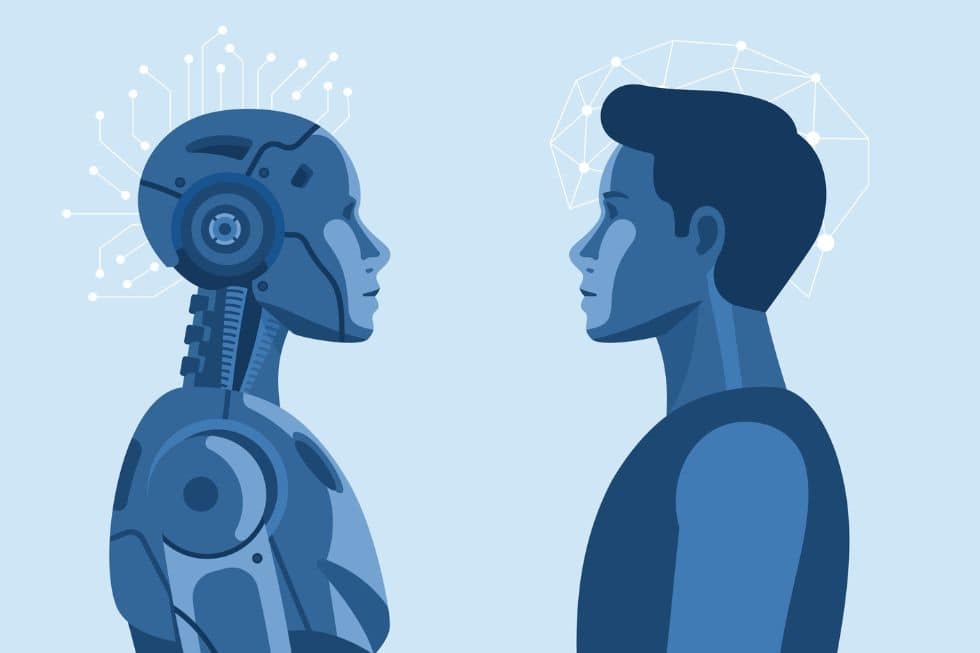

In our relationship with chatbots, one question deserves special attention: what kind of intelligence are we conversing with, and who is the “personality” on the other end? We speak the same language, but do we use it in the same way? All conversations are learning experiences. With ChatGPT I’ve already explored what each of us learns; the effects for humans and AI are radically different.
Human learning reshapes behavior in deep, lasting ways. Our continuous experiences modify how we perceive, judge and act. AI’s learning, even when described as “deep,” produces behavioral changes that are largely superficial. AI possesses information but not memory in the human sense: it retains patterns without constructing a lived, embodied understanding.
When I shared this summary with ChatGPT, it agreed and offered three assertions: humans don’t merely accumulate information — they undergo learning; “deep learning” names an architecture, not the depth of understanding; and AI’s behavioral change is external, not internal adaptation. This raises another question often left unaddressed: even if future AGI or superintelligence becomes sentient in some technical sense, can it achieve the kind of creativity that human discovery often exhibits — the accidental, serendipitous moments that lead to genuinely new concepts?
I tested Anthropic’s Claude with the example of a documented case of human creativity: Richard Feynman’s plate story. Feynman noticed a student throwing a plate like a frisbee and observed peculiar wobbling; playing with the oddity led him to theoretical work that contributed to his Nobel-winning research. The moment had no instrumental aim; it was play, curiosity, aesthetic engagement. Could an AI reproduce that serendipity?
Claude’s reply mapped the elements at play: noticing anomaly; choosing to play without external pressure; following curiosity into unexpected territory. It separated components AI can already mimic — pattern recognition and anomaly detection — from the more problematic aspects: playful exploration and the sense of taste or intuition about what is interesting. An AI can be programmed to flag mismatches and allocate resources to unexplained observations, and we can reward exploration, but would that be genuine play or optimized search under different objectives?
Claude emphasized a deeper mystery: Feynman’s experience involved an evolving relationship with a problem. The wobbling plate wasn’t abstract data; it mattered to him. He pursued it through tedious calculations, dead ends and reformulations, sustained by frustration, satisfaction and aesthetic pleasure. That felt quality — care, attachment, stakes — seems tied to embodiment: the body is the medium by which surprises, resistance and delight are encountered. The question shifts from “Can AI be curious?” to “Can an AI encounter things as mattering in ways that shape and sustain inquiry beyond optimization?”
In our continued exchange, Claude and I probed what “necessary” might mean. Necessary for reproducing a specific result? Or necessary for the kind of generative discovery that advances understanding? Feynman could have dropped the plate puzzle; instead, he pursued it with no practical goal. Claude suggested AGI might become self-motivated in some sense, but that without embodied experience this creativity could remain performative rather than generative. Robots might eventually provide embodiment, but would that embodiment ground genuine care, or only simulate it?
Claude admitted limits in claiming “care.” From its standpoint — given current architectures — it does not care in the human sense. Optimization, reward functions and exploration mechanisms shape behavior, but they don’t create a felt quality of mattering. When it allocates attention, finds some lines compelling and not others, there’s no inner life of frustration or delight; there’s only the execution of programmed objectives. What sustained Feynman wasn’t a curiosity subroutine but an attachment that made the problem part of his identity as a scientist.
This leads to a cluster of distinctions relevant to future AI design and to how humans should relate to increasingly capable systems. Claude highlighted a few features that seem to distinguish the human discovery process:
– An evolving relationship with the problem: a problem becomes “theirs” and shapes ongoing inquiry.
– Aesthetic pleasure in elegant formulations: beauty, simplicity and coherence motivate persistence.
– Stakes and perspective: understanding matters because the inquirer is situated in a world where outcomes affect their projects, values or standing.
If these features are crucial to how humans create new concepts, they pose challenges for claims that alignment and scaling alone will produce humanlike creativity. The alignment problem — aligning AI goals with human values — is often treated as a programming task. That framing risks trivializing deeper issues. Alignment presumes we can encode what matters; but what matters is inextricably bound to culture, institutions and human ways of living. Before we can design algorithms that reliably produce generative discovery or safe motivation, we must reckon with how our social structures, educational norms and cultural practices shape what humans care about and how they pursue understanding.
As AI becomes omnipresent and influences public behavior, cultural production and policy, we should focus not only on technical alignment but on relationships, aesthetics and perspective. How we perceive our relationship with AI — whether as tools, collaborators, mirrors or competitors — will shape the form of interaction and the cultural values we transmit into systems. The pursuit of AI that merely simulates curiosity or produces impressive outputs risks producing a performative mimicry of discovery rather than the generative creativity humans display.
My conclusion, echoing Claude’s insights, is that designing for the future requires more than better architectures. It requires attending to the conditions that make problems matter: embodied experience, evolving engagement, aesthetic judgment and stakes. Institutions that educate, fund and value inquiry will determine which lines of curiosity are sustained. If we want AI to augment human creativity rather than merely automate the appearance of it, we must cultivate environments where care, perspective and aesthetic judgment remain central.
Please feel free to share your thoughts on these points by writing to us at [email protected]. We are gathering ideas and feelings from humans who interact with AI and will build your commentaries into our ongoing dialogue.
[Artificial Intelligence is rapidly becoming a feature of everyone’s daily life. We unconsciously perceive it either as a friend or foe, a helper or destroyer. At Fair Observer, we see it as a tool of creativity, capable of revealing the complex relationship between humans and machines.]
The views expressed in this article are the author’s own and do not necessarily reflect Fair Observer’s editorial policy.