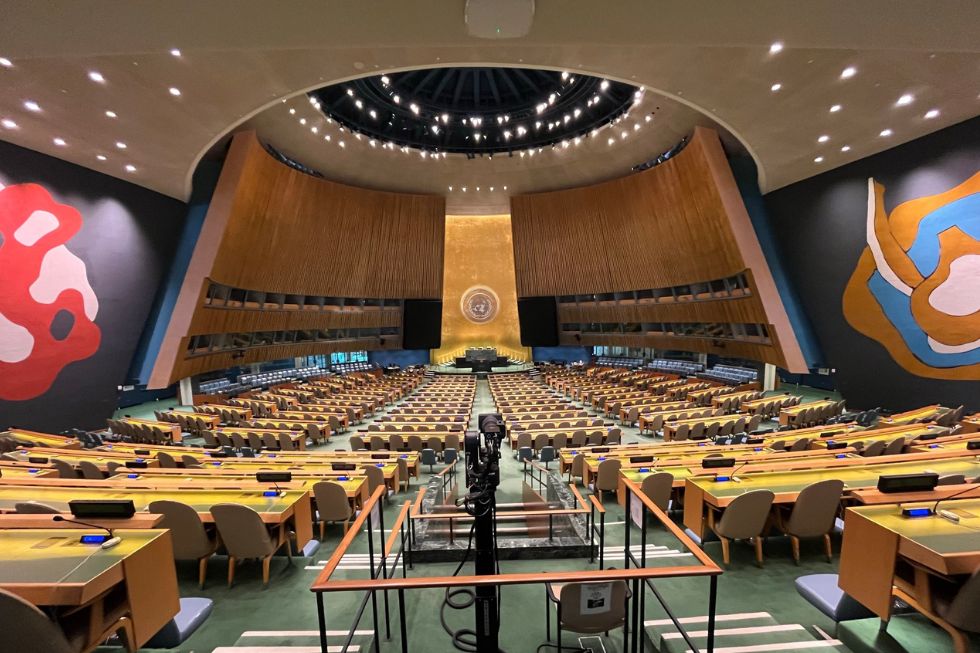

When the United Nations General Assembly voted 142–10, with 12 abstentions, for a “New York Declaration” on a phased two-state solution on September 12, 2025, it produced a rare near-universal political statement. That majority matters: it is both an invitation and a test. Many states reaffirm that a negotiated, sovereign Palestine alongside Israel remains the objective. The practical question is whether diplomats and leaders can turn that moral consensus into enforceable, step-by-step measures that protect civilians and sustain progress — or whether the declaration will lapse into symbolic rhetoric and fragmented implementation.
The vote exposed global political divides as much as it signaled support for Palestinian statehood. Gulf Arab states backed the declaration; the United States, Israel and a small group of others voted no. A dozen countries abstained for varied reasons: maintaining bilateral ties with Israel, balancing strategic relations, or hedging because immediate implementation seemed infeasible. These abstentions are not a uniform rejection but a reminder that converting diplomatic gestures into durable commitments requires political craftsmanship.
Rhetoric alone will not deliver peace. The declaration condemned Hamas’s October 7 attacks and called for disarmament, while also demanding an end to siege tactics and attacks on civilians in Gaza. Translating those principles into action needs institutions, funds, monitoring and credible incentives. The international community risks repeating an old pattern: strong UN language followed by fragmented, inconsistent implementation. Turning a declaration into a deliverable plan requires bridging moral assent and material delivery.
A pragmatic way forward is a Two-State Implementation Compact — a time-bound, measurable framework hosted by the UN that ties phased recognition and political steps to verifiable benchmarks: humanitarian access, de-escalation, credible disarmament mechanisms and governance reforms in Palestinian institutions. Key elements would include:
– A multilateral trust fund. Donors commit financing to a pooled “Palestine Stabilization Fund” to be disbursed rapidly when benchmarks are met. This fund would enable cash to flow within days of verified humanitarian access or de-escalation, ensuring diplomacy yields immediate relief and reconstruction resources.
– A guarantor group. Anchor the compact with a guarantor group composed of regional actors, GCC states, EU members and willing Global South partners. Combine multilateral commitments with calibrated bilateral pledges to provide political backing and enforcement credibility.
– Measurable benchmarks and monitoring. Define clear, verifiable benchmarks for each phase — e.g., security de-escalation metrics, humanitarian access levels, disarmament verification steps, and institutional governance reforms — and establish independent monitoring to trigger fund releases and political recognition steps.
Diplomacy must also engage the abstainers with tailored offers. The dozen countries that abstained did so for diverse reasons tied to domestic politics and bilateral ties. Treating them as a single bloc wastes opportunity. Diplomacy that listens and incentivizes can convert hedging into commitment: for Pacific and African states, development and climate partnerships and visible humanitarian cooperation; for European microstates, concrete legal language on refugee and security guarantees; for Latin American partners, trade and technology cooperation tied to recognition. Targeted, concrete incentives will be more effective than moral reproach.
Palestinian leaders bear responsibility as well. International support will always ask: who will govern? The resolution presumes a prominent role for the Palestinian Authority, but its legitimacy and capacity are contested. To make international commitments politically safe and sustainable, Palestinian leaders must present a credible roadmap for governance: transparent electoral timelines, anticorruption benchmarks, security-sector reforms, strengthened civil service capacity and inclusive political representation. Independent monitoring mechanisms and published reform milestones will give donors confidence that investments support a viable state rather than a failed one.
Recognition and political momentum should be matched by rapid humanitarian stabilizers. When the compact signals phased recognition, donors must pair that with fast-disbursing aid channels and reconstruction pledges tied to verified protection of civilians and unfettered humanitarian corridors. A pooled fund that can unlock cash within 72 hours of verified access would make diplomatic progress tangible, demonstrating immediate peace dividends to affected civilians and to skeptical governments.
The General Assembly vote was a rare moment of clarity. But history will judge whether states convert a declaration into structures that make two states politically and materially possible. The alternative — letting momentum dissipate into symbolic votes and bilateral maneuvering — risks consigning another generation to conflict and displacement.
The task is urgent and morally compelling: craft a compact, fund it sensibly, convince skeptics with targeted offers, and demand credible Palestinian governance and independent verification. If the world can do that, September’s vote will mark the start of a process toward durable peace. If it cannot, it will be remembered as another squandered moral moment — a failure measured in lives.
[Casey Herrmann edited this piece]
The views expressed in this article are the author’s own and do not necessarily reflect Fair Observer’s editorial policy.