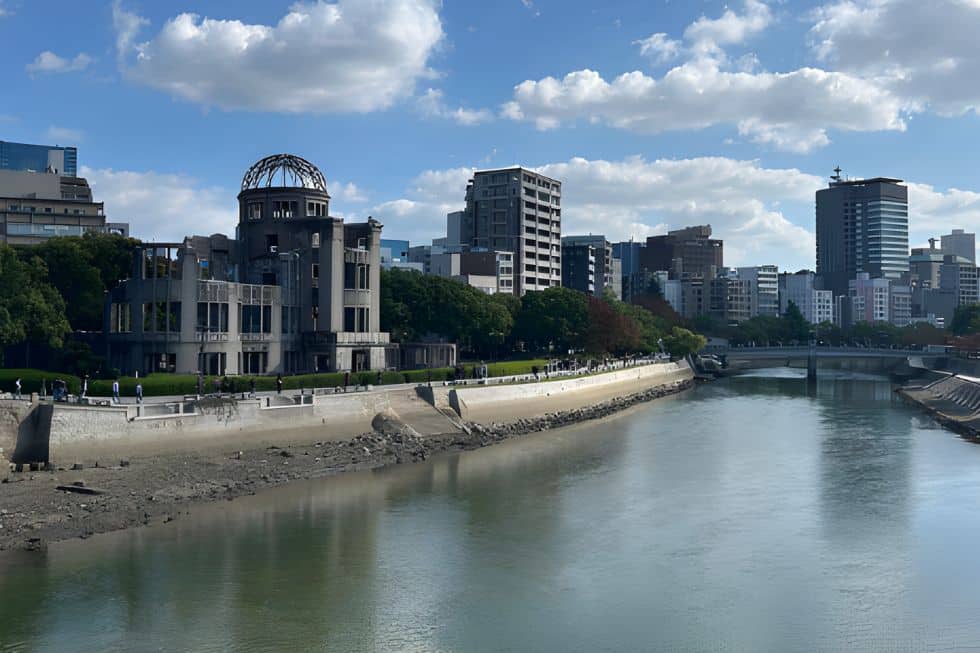

I visited Hiroshima three times in nine months, each trip framed by different personal and professional intentions. Without the plaques, memorials and the Genbaku Dome, it would be hard to imagine that this tranquil city endured “hell on earth” 80 years ago. The memorials mark a past that coexists with ordinary life: grandmothers with slow gaits, gray-haired men, uniformed middle schoolers. Any one of them might be a Hibakusha (a survivor), a child of survivors, or a descendant of those who suffered discrimination because of exposure or because they were brought to Japan against their will. The past is present in mundane gestures and in the quiet dignity of people going about daily life.
Seeing everyday humanity in Hiroshima erases the easy abstractions that make violence tolerable in history books. When the gestures and mannerisms of Hibakusha remind me of my own grandparents, whatever unconscious rationalizations I might hold as an American evaporate. Citizens are often treated as pawns in militaristic systems—sacrificed not for collective good, but for the aims of leaders and commanders. Meeting survivors and hearing their stories makes the human cost immediate and undeniable.
Hiroshima taught me to lean into the humanitarian in myself and to urge others to do the same. As an aspiring public servant and diplomat from the United States, I carry the responsibility of remembering the human component in policy. Campaigning and negotiations easily reduce people to statistics or strategic variables. The moral task is to treat individuals as ends in themselves rather than means to political or professional ends. I refuse to accept that entering public life requires a decline in moral character.
Edward O. Wilson’s warning resonates here: “The real problem of humanity is the following: We have Paleolithic emotions, medieval institutions and godlike technology.” That combination is dangerous, especially when power and technology are divorced from moral restraint. Technological progress can solve technical problems—better medicine, cleaner energy—but it cannot replace the hard work of human dialogue that underpins trust between individuals, communities and nations.
Across my visits, I was fortunate to engage in meaningful conversations with students, activists and Hibakusha. I took part in programs like the Hiroshima–ICAN Academy and interviewed peace leaders and organizations, including members connected to Nihon Hidankyo. Those dialogues—across generations and nationalities—are the building blocks of understanding. They do not eliminate political conflict, but they humanize those on the other side and create unexpected alliances for peace.
In a world overwhelmed by conflicts in places such as Ukraine, Gaza and Sudan, individual action often feels insignificant compared with summits, treaties and military actions. Yet grassroots exchanges—conversations between groups irrespective of nationality—foster understanding and build connections that can ripple outward. Hope matters: losing it now makes us impotent when we need resilience most.
To my fellow Americans: our political system offers privileges and responsibilities. We, more than many, can shape both domestic policy and international norms. But remember that people are not their governments. Many around the world lack the luxury to dissent; they risk imprisonment or death for speaking truth to power. When we engage globally, we must center human dignity.
Hiroshima’s lesson is simple and profound: the best weapon is to sit down and talk. Holding onto that humanitarian impulse—listening, learning, acknowledging harm—must guide public service and diplomacy. If anything, Hiroshima asks us to place human dignity at the center of policy and to ensure that technological and political power are always tempered by moral responsibility.
[Kaitlyn Diana edited this piece.]
The views expressed are the author’s own and do not necessarily reflect Fair Observer’s editorial policy.