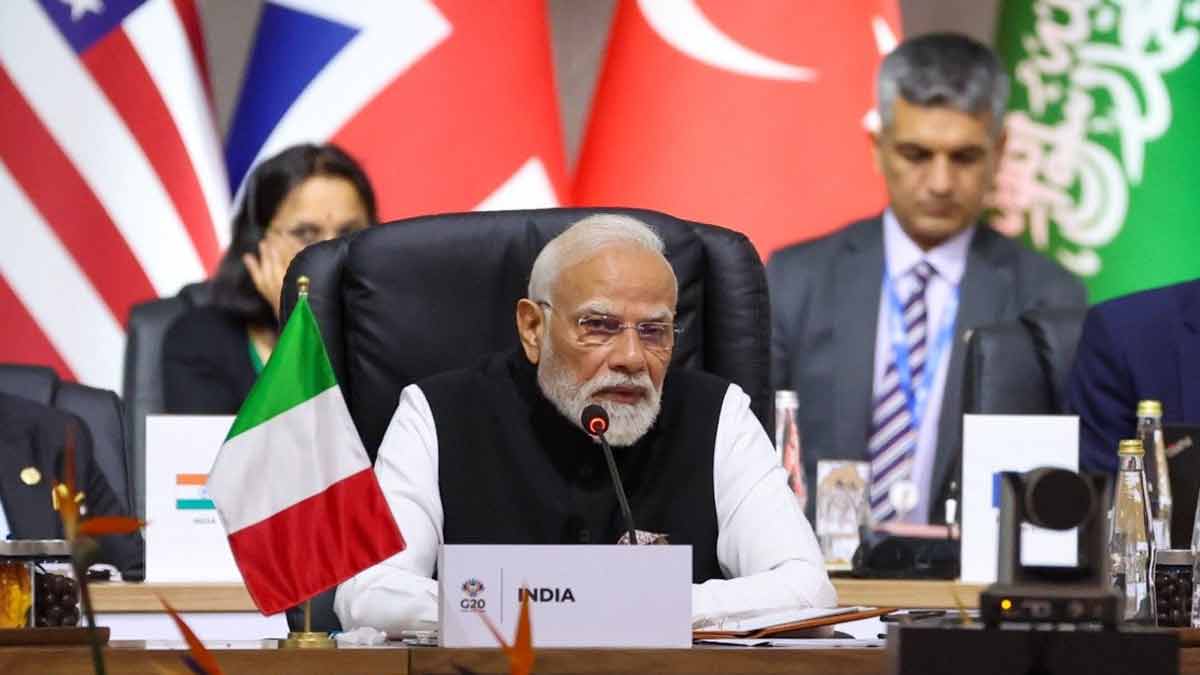

Prime Minister Narendra Modi proposed six initiatives for global development at the G20 Leaders’ Summit in Johannesburg, outlining India’s approach to inclusive growth, resilience and well-being.
The six proposals are:
– G20 Open Satellite Data Partnership: G20 space agencies would make satellite data available to developing countries to support agriculture, fisheries, disaster management and other applications.
– G20 Critical Minerals Circularity Initiative: To aid clean energy transitions by promoting recycling, urban mining, second-life batteries, easing supply chain pressures and advancing joint research on critical minerals.
– Global Traditional Knowledge Repository: A documented repository of traditional wisdom and time-tested sustainable living models to preserve and pass on collective knowledge for health and well-being.
– Africa Skills Multiplier programme: Aiming to create one million certified trainers to build local capacities and skill youth across Africa, fostering long-term development.
– G20 Global Healthcare Response Team: A roster of healthcare experts from each G20 country who can be deployed to respond to health challenges worldwide.
– Countering the Drug-Terror Nexus: An initiative to tackle drug trafficking and dismantle the drug-terror economy.
Speaking in a session titled “A Resilient World — the G20’s Contribution: Disaster Risk Reduction, Climate Change, Just Energy Transitions, Food Systems,” Modi emphasized that “it is clear that to deal with natural disasters, we will have to strengthen global cooperation.” He argued resilience cannot be built in silos and called for greater collaboration among G20 members.
Modi reiterated India’s commitment to sustainability and clean energy: “India is fully committed to sustainability and clean energy, which is why we propose a G20 Critical Minerals Circularity Initiative to promote recycling, urban mining, second-life batteries and related innovations.”
He noted India had established a Disaster Risk Reduction Working Group during its G20 Presidency and stressed that disaster resilience should move beyond being “response-centric” to a “development-centric” approach, citing the Coalition for Disaster Resilient Infrastructure (CDRI) as an example of that vision.