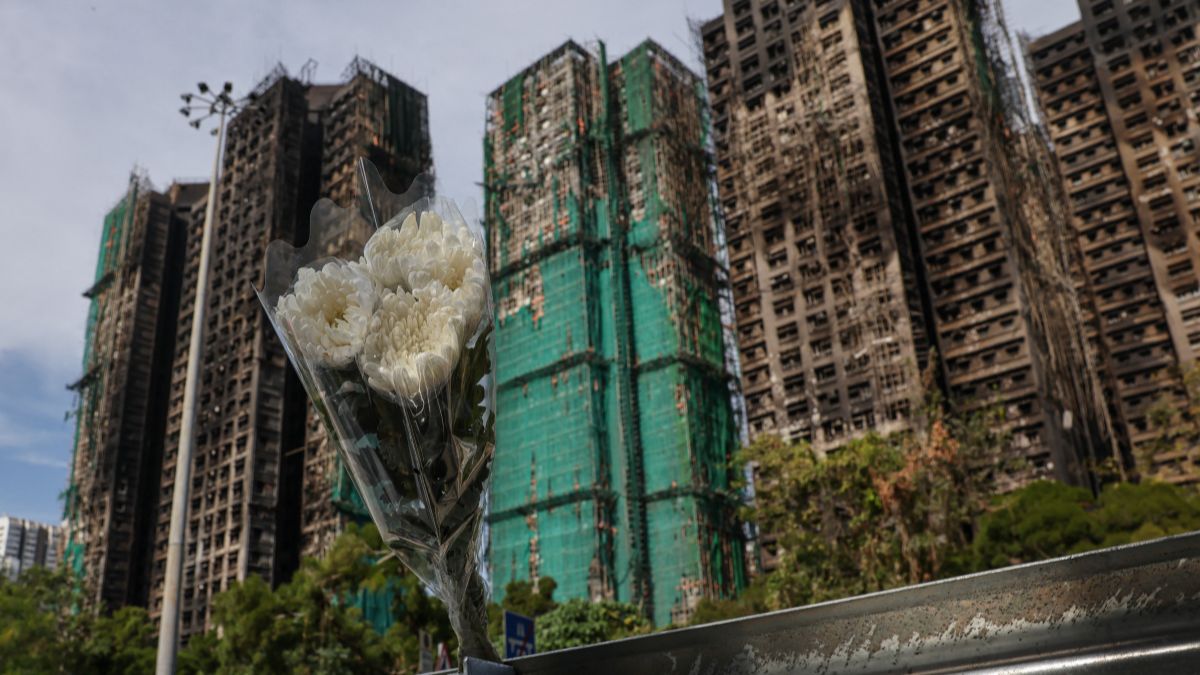

The death toll of the blaze at an apartment complex in Hong Kong has reached 128 as of Friday. Officials said rescue operations were coming to an end, with about 16 bodies still inside the buildings, they said at a press conference.
Firefighters continued searching the burned high-rises after a massive blaze broke out and spread across seven of eight towers at the Wang Fuk Court housing complex in Tai Po. The estate had housed more than 4,600 people. Authorities reported 124 people were found dead at the scene and four were declared dead at hospital.
Are the bamboo scaffolds to blame for the spread of the fire?
The eight towers were all undergoing renovations and were wrapped in bamboo scaffolding and green mesh. Initially some believed the bamboo and mesh caused the fire to spread. Hong Kong netizens noted the scaffolding appeared intact around 3 a.m. after flames were contained, and many defended bamboo’s fire-resistant qualities on social media, while pointing out the mesh nets are flammable.
Authorities said highly flammable styrofoam material and plastic sheets on the buildings’ windows used in the renovation caused the fires to spread quickly. Secretary for Security Chris Tang Ping-Keung said the ignited styrofoam produced extremely high temperatures, which in turn set the netting and the bamboo scaffolding alight.
Officials had pushed for fire-resistant steel instead of bamboo before the fire, but that proposal faced criticism as benefiting mainland China’s steel industry. The disaster has accelerated the push toward metal scaffolding, with Chief Executive John Lee saying the government was considering replacing bamboo scaffolding with metal frameworks.
Who is responsible?
A majority of the dead were found in two of the seven towers that caught fire. The status of about 200 people remains unclear. Twelve firefighters were injured while tackling the blaze.
About 25 calls for help during the fire are still unresolved, the Fire Services said; Deputy Director Derek Armstrong Chan told reporters officials had been unable to reach some callers.
Fire Services director Andy Yeung said the department found the fire alarms in the estate’s eight buildings could not function properly and that prosecution would follow. Several residents said the fire alarm in the buildings did not go off. Apartment owner Kiko Ma said alarms had been turned off amid renovation works, calling the tragedy preventable: “This was preventable… A lot of people did not do their duties,” she told the BBC. Residents also reported construction workers smoking and said cigarette butts were found on window ledges.
The complex was built in the 1980s. Nearly 40% of the 4,600 residents were aged 65 or older, and many were foreign nationals; 19 Filipino domestic workers who lived in the estate are still missing.
Two directors from Will Power Architects, the consultant firm in charge of the renovation project, were arrested by Hong Kong’s Independent Commission Against Corruption (ICAC) on Friday. Earlier, three senior staff members of renovation company Prestige Construction & Engineering Co Limited were arrested for alleged manslaughter. The ICAC has launched a corruption probe into the repair works, which cost around HK$330 million (US$42.43 million). The incident has prompted calls for stronger fire safety laws in construction.