
The Lebanese army has increased its presence in areas along the border with Israel that saw heavy fighting during the 14-month Israel-Hezbollah war. Once off-limits and dominated by Hezbollah, parts of the zone south of the Litani River and north of the Israeli border are now being patrolled and occupied by national forces.
Since the ceasefire a year ago, the army has deployed nearly 10,000 troops in the sector, shut 11 smuggling crossings along the Litani, and has dealt with large quantities of unexploded ordnance, senior army officers said. Journalists were taken Friday, November 28, on a tour of the rugged border area, where troops were visible in places formerly held by Hezbollah.
Israel has continued almost daily airstrikes since the November 2024 ceasefire, mostly aimed at Hezbollah members; the office of the UN High Commissioner for Human Rights says 127 civilians have been killed. Hezbollah says it has claimed responsibility for only one attack on an Israeli military post since last November and asserts it no longer maintains an armed presence south of the Litani. The group has refused to discuss full disarmament across Lebanon until Israel ends its strikes and withdraws from five hilltop positions it captured during the war and still occupies.
The latest conflict began Oct. 8, 2023, after Hamas attacked southern Israel and Hezbollah launched rockets into Israel in solidarity. Israel responded with a widespread bombardment of Lebanon and a subsequent ground invasion that severely weakened Hezbollah. In August, Lebanon’s government approved a U.S.-backed plan to disarm Hezbollah; the group rejected the plan. Israel has recently warned that Hezbollah is working to rebuild capabilities in southern Lebanon.
Brig. Gen. Nicolas Thabet, the Lebanese army commander in the sector south of the Litani, said the army is making “tremendous efforts” during a critical period and is making “major sacrifices” in what he called one of the most dangerous parts of the Middle East.
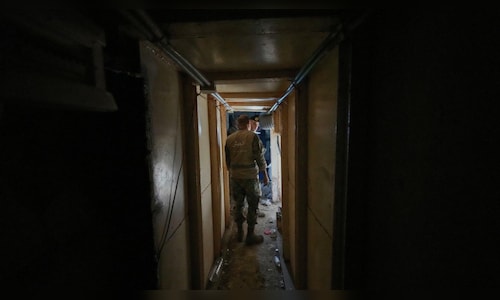
Journalists visited Zibqin Valley, where Hezbollah once operated rocket launchers, tunnels and hidden posts. The area now shows no militant presence; former positions were either destroyed or are controlled by the army. A nearly 100-meter tunnel inside a mountain contained what appeared to be a small medical clinic, ventilation, power cables, water tanks and large amounts of canned food. Zibqin Valley was also the site of an August explosion in an arms depot that killed six army experts dismantling munitions.
Army officers reported 5,198 violations by Israel since the ceasefire, including 657 airstrikes. They said the war destroyed 13,981 housing units and damaged infrastructure in border villages. Some weapons and ordnance found have been dismantled or detonated; usable arms have been seized and others placed in storage.
The army now operates about 200 posts south of the Litani River, alongside 29 fixed checkpoints and round-the-clock patrols. After the government’s September 5 decision to pursue Hezbollah’s disarmament, troops discovered 74 tunnels, 175 rocket launchers and 58 missiles.
Thabet said the army does not enter private homes to search without a judicial order and only conducts searches if illegal activity is witnessed.
By AP
November 29, 2025
(Edited by : Gareema Bangad)