
The Trump administration announced a tougher immigration stance after an Afghan national was charged in the shooting of two National Guard members, unveiling new limits aimed at Afghans already resettled in the U.S. and those seeking entry — many of whom served with American forces during the two-decade war.
Officials said the administration is pausing all asylum decisions following the attack. Those awaiting entry were already subject to stricter measures under President Trump’s broad crackdown on legal and illegal migration that began when he took office for a second term in January.
Experts and advocates note that many Afghans in the U.S. were heavily vetted, often undergoing years of security screening. “He was vetted both before he landed, probably once he landed, once he applied for asylum,” said Andrew Selee, president of the Migration Policy Institute, referring to the suspected shooter. “But more importantly, he was almost certainly vetted extensively and much more by the CIA.” Haris Tarin, who worked on the Biden-era resettlement programme, said the case is more likely to expose failures in integration than screening: “This is not a failure of screening. This is a failure of us not being able to integrate — not just foreign intelligence and military personnel — but our own veterans.”
The initial evacuation effort, Operations Allies Welcome, brought roughly 76,000 Afghans to the United States. The program ran for about a year before transitioning to a longer-term Operation Enduring Welcome; together the efforts have resettled nearly 200,000 Afghans in the U.S.
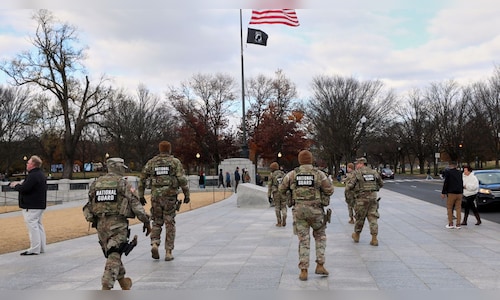
The suspect, identified as 29-year-old Rahmanullah Lakanwal, is accused of killing 20-year-old Specialist Sarah Beckstrom and wounding 24-year-old Staff Sgt. Andrew Wolfe, who remains in critical condition. Lakanwal, who worked with the CIA during the Afghanistan war, applied for asylum under the Biden administration; advocacy group #AfghanEvac says his request was approved in April after extensive vetting.
In the attack’s immediate aftermath, the State Department temporarily stopped issuing visas to people traveling on Afghan passports, an announcement posted on X by Marco Rubio. Trump and his allies sharply criticized vetting and admission practices. CIA Director John Ratcliffe said Lakanwal “should have never been allowed to come here.” Trump called lax migration policies “the single greatest national security threat facing our nation,” while Vice President J.D. Vance accused the prior administration of “opening the floodgate to unvetted Afghan refugees.”
Those criticisms quickly turned into policy declarations. Trump said he would “permanently pause all migration” from nearly 20 countries, “terminate all of the millions of Biden illegal admissions,” and “remove anyone who is not a net asset to the United States.” Many measures he cited had already been implemented via executive orders over the past 10 months, including actions in June. “They are highlighting practices that were already going into place,” said Andrea Flores, an immigration lawyer who served as an adviser in the Obama and Biden administrations.
Advocates warn the response risks unfairly targeting entire communities. Krish O’Mara Vignarajah, president and CEO of Global Refuge, said the moves “cast suspicion on entire nationalities, including Afghan allies who risked their lives to protect our troops.” She added that previously lawfully admitted families are already experiencing disruption and fear, and that tying broad policy shifts to a single act of violence is troubling.
For many Afghans in the U.S., the developments have provoked fear and uncertainty about legal status and community reception. Nesar, 22, who asked to be identified by his first name, said he had begun to settle into American life after arriving weeks after Kabul fell. He had learned English, found work and was awaiting a December green card interview — but now worries the application and his safety could be in jeopardy. “Life was finally getting easier for me,” he said. “But after this happened … I was feeling so uncomfortable among all of those people. I was like, maybe they’re now looking at me the same way as the shooter.”
Another Afghan, who had received a special immigrant visa two years earlier after fearing for his life under the Taliban, said he hoped to contribute to U.S. society using his experience as a defense attorney. He now fears renewed scrutiny. “It seems that whenever a terrorist commits a crime, its shadow falls upon me simply because I am from Afghanistan,” he said.
The shooting has prompted calls for re-examining admissions and for reviewing green card holders from countries of concern, while raising broader questions about vetting, integration and the lasting obligations the U.S. bears toward those who aided American forces.